

Views
Everything a screen's body returns is a view: a text, a list, a stack of
either, a modifier around any of them. A view is told how much room it has,
says how big it wants to be, declares what can be touched and paints itself.
It is built for one frame and dropped.
Writing a widget is the guide to building one, and how a frame runs is where the passes fit. This page is what each piece does.
Topics
Section titled “Topics”View | A node in the UI tree. |
ViewExt | Chainable helpers available on every view. |
view::Mapped | A component's view, with its messages translated into its parent's. |
A node in the UI tree.
pub trait View<M>M is the message type of the screen the view sits in: a control carries
values of M and hands them back when touched, so a screen matches on its own
enum. A view that sends nothing, such as Text or Divider, is a View<M>
for every M.
Every frame walks the tree in three passes:
| Pass | Method | What it does |
|---|---|---|
| 1 | measure | records the size the view wants within what it is offered |
| 2 | interactions | declares what can be touched, where it finally sits, and learns which declaration holds focus |
| 3 | render | paints |
Implemented by every widget, stack and modifier; by Box<V> for any view V,
including Box<dyn View<M>>; and by view::Mapped.
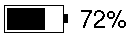
Example — a battery gauge
use xpui::{Point, Rect, Renderer, Size, View};
struct Battery {  percent: i32,  measured: Size,}
impl Battery {  fn new(percent: i32) -> Self {    Battery { percent: percent.clamp(0, 100), measured: Size::ZERO }  }}
impl<M> View<M> for Battery {  fn measure(&mut self, available: Size) {    // 64 by 28 when there is room, and never more than was offered.    self.measured = Size::new(64.min(available.width), 28.min(available.height));  }
  fn size(&self) -> Size {    self.measured  }
  fn render(&self, origin: Point) {    let Size { width, height } = self.measured;    Renderer::stroke_rect(Rect::new(origin.x, origin.y, width - 4, height));    Renderer::fill_rect(Rect::new(origin.x + width - 4, origin.y + height / 3, 4, height / 3), true);    let fill = (width - 10) * self.percent / 100;    Renderer::fill_rect(Rect::new(origin.x + 3, origin.y + 3, fill, height - 6), true);  }}
let row: xpui::HStack<()> = xpui::hstack![12; Battery::new(72), xpui::Text::new("72%")]  .align(xpui::Alignment::Center);
Example — a control that draws its own focus
use xpui::{InputMask, Interactions, Point, Rect, Renderer, Size, Trigger, View};
struct Swatch<M> {  message: M,  focused: bool,  measured: Size,}
impl<M: Clone> View<M> for Swatch<M> {  fn measure(&mut self, available: Size) {    self.measured = Size::new(40.min(available.width), 40.min(available.height));  }
  fn size(&self) -> Size {    self.measured  }
  // Runs before `render` on every paint, so the answer is this frame's.  fn interactions(&mut self, origin: Point, out: &mut Interactions<M>) {    let trigger = Trigger::Message(self.message.clone());    self.focused = out.declare(self.bounds(origin), InputMask::DEFAULT, trigger);  }
  fn render(&self, origin: Point) {    let rect = self.bounds(origin);    Renderer::stroke_rect(rect);    if self.focused {      Renderer::fill_rect(Rect::new(rect.x() + 4, rect.y() + 4, rect.width() - 8, rect.height() - 8), true);    }  }}
let mut swatch = Swatch { message: "ink", focused: false, measured: Size::ZERO };swatch.measure(Size::new(480, 800));
let mut out = Interactions::new(0); // focus is on the first stopswatch.interactions(Point::ORIGIN, &mut out);assert!(swatch.focused);assert_eq!(out.focusable_count(), 1);
Example — measuring a view outside a tree
use xpui::{Size, Text, View};
xpui::testing::install();let mut text = Text::new("Battery");View::<()>::measure(&mut text, Size::new(480, 800));assert!(View::<()>::size(&text).width > 0);
Text is a View<M> for every M, so a call outside a tree has to say which
one it means, and () is the usual choice. Inside a tree this never comes up:
the stack knows its message type and passes it down. Text measures through the
host's font metrics, which is why the host is installed first.
Required methods
Section titled “Required methods”View::measure
Section titled “View::measure”Compute and store the size this view wants within available.
fn measure(&mut self, available: Size)| Parameter | Meaning |
|---|---|
available | The most room the parent can give. A scroll view offers UNBOUNDED height, a large number rather than i32::MAX, so a sum of children cannot overflow. |
Store the answer, since size is asked afterwards and more than once. A stack
measures its fixed children first and offers flexible ones what they left, so a
flexible view's available is the remainder.
View::size
Section titled “View::size”The size recorded by the most recent measure.
fn size(&self) -> SizeA parent reads it after measure, to place the view and to size itself.
View::render
Section titled “View::render”Paint with the view's top-left corner at origin.
fn render(&self, origin: Point)Paint through Renderer, within the size recorded by measure. A container
renders each child at the origin it gave that child in interactions.
Provided methods
Section titled “Provided methods”View::interactions
Section titled “View::interactions”Declare any interactive regions, given this view sits at origin.
fn interactions(&mut self, origin: Point, out: &mut Interactions<M>)Non-interactive leaves keep the default and declare nothing.
| Parameter | Meaning |
|---|---|
origin | Where the view sits on the panel: the same origin render receives. |
out | The frame's table. declare adds a rectangle, a mask and a trigger, and returns whether that declaration holds focus. |
It takes &mut self so a view can keep that answer for render, which runs
after it. Writing a widget
explains the masks.
View::is_flexible
Section titled “View::is_flexible”Whether this view absorbs leftover space along its parent's stacking axis.
fn is_flexible(&self) -> boolFlexible views are measured in a second pass, against only what the fixed-size
siblings left behind. Spacer and the flexible() modifier say yes.
View::contributes_cross_size
Section titled “View::contributes_cross_size”Whether this view's measured size counts towards its parent's extent across the stacking axis.
fn contributes_cross_size(&self) -> boolOnly Spacer says no. A spacer records the whole cross extent it is offered,
so counting it would make an HStack as tall as the space it was offered rather
than as tall as its content.
View::bounds
Section titled “View::bounds”This view's own bounds when placed at origin.
fn bounds(&self, origin: Point) -> RectThe origin and the measured size, as a Rect: what most views declare as
their touch target.
See also: ViewExt, Screen::body
ViewExt
Section titled “ViewExt”Chainable helpers available on every view.
pub trait ViewExt<M>: View<M> + SizedImplemented for every sized view, so importing the trait is all it takes. The
modifiers that change layout or add a tap, such as frame and on_tap, are a
separate trait, Modifiers.
Example — one stack of different views
use xpui::{Divider, Text, VStack, View, ViewExt};
let rows: Vec<Box<dyn View<()>>> = vec![  Text::new("Wi-Fi").boxed(),  Divider::new().boxed(),  Text::new("Bluetooth").boxed(),];let tree: VStack<()> = VStack::new(8).extend(rows);
Example — a component with its own messages
use xpui::{Modifiers, Screen, Text, View, ViewExt, vstack};
#[derive(Clone, Copy)]enum UnitMsg {  Cycle,}
struct Units {  binary: bool,}
impl Units {  /// Tapping the figure cycles the units, a message the screen never sees.  fn view(&self, bytes: i32) -> impl View<UnitMsg> + use<> {    let text = if self.binary {      format!("{} KiB", bytes / 1024)    } else {      format!("{} kB", bytes / 1000)    };    Text::new(text).on_tap(UnitMsg::Cycle)  }
  fn update(&mut self, message: UnitMsg) {    match message {      UnitMsg::Cycle => self.binary = !self.binary,    }  }}
#[derive(Clone, Copy)]enum Msg {  Units(UnitMsg),}
struct Storage {  units: Units,  free: i32,}
impl Screen for Storage {  type Message = Msg;
  fn body(&self) -> impl View<Msg> {    vstack![8;      Text::new("Free space"),      self.units.view(self.free).map(Msg::Units),    ]  }
  fn update(&mut self, message: Msg) {    match message {      Msg::Units(inner) => self.units.update(inner),    }  }}
let mut storage = Storage { units: Units { binary: false }, free: 182_000 };storage.update(Msg::Units(UnitMsg::Cycle));assert!(storage.units.binary);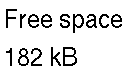
A component owns its state and declares its own message type, and the parent
folds it in with .map(). Its controls keep their place in the parent's focus
order, exactly where they appear in the tree. There is no registration and no
trait to implement: a plain fn thing(..) -> impl View<M> + use<M> is a
component too.
Provided methods
Section titled “Provided methods”ViewExt::boxed
Section titled “ViewExt::boxed”Erase this view's type, for collecting views of different shapes.
fn boxed(self) -> Box<dyn View<M>>where Self: 'static,A Box<dyn View<M>> is itself a view, so the result goes anywhere a view goes.
Containers take views by value, and a tree whose shape is fixed never needs
this. It is for a Vec of mixed views, or the two branches of an if that
build different types.
ViewExt::map
Section titled “ViewExt::map”Translate this view's messages into another type.
fn map<P>(self, convert: fn(M) -> P) -> Mapped<Self, M, P>| Parameter | Meaning |
|---|---|
convert | A function from the view's message to the parent's, usually the parent's enum variant: Msg::Units. A fn pointer, not a closure, so it captures nothing. |
A message a control built with the tree is converted as it is declared; a value resolved from a touch or a key is converted when it resolves. Layout, painting and focus pass through unchanged.
See also: view::Mapped, Modifiers
view::Mapped
Section titled “view::Mapped”A component's view, with its messages translated into its parent's.
pub struct Mapped<V, N, M>Built by ViewExt::map, and named only when a function returns
one without impl View.
| Parameter | Meaning |
|---|---|
V | The component's view. |
N | The component's message type, what V sends. |
M | The parent's message type, what the Mapped sends. |
It measures, renders and reports flexibility exactly as V does. While
declaring, it collects V's interactions into a table of its own and converts
each trigger into M, so every focus stop inside stays a focus stop, in
order.
Example — the same size, another message type
use xpui::view::Mapped;use xpui::{Size, Text, View, ViewExt};
#[derive(Clone, Copy)]enum UnitMsg {  Cycle,}
#[derive(Clone, Copy)]enum Msg {  Units(UnitMsg),}
xpui::testing::install();let mut plain = Text::new("182 kB");let mut mapped: Mapped<Text, UnitMsg, Msg> = Text::new("182 kB").map(Msg::Units);
View::<UnitMsg>::measure(&mut plain, Size::new(480, 800));mapped.measure(Size::new(480, 800));assert_eq!(mapped.size(), View::<UnitMsg>::size(&plain));
See also: ViewExt::map, View