

Painting lists
The three themed components xpui asks a backend to paint for rows of content:
a list, a dialog of options over it, and the scroll indicator beside a region
taller than its window. Each is a plain function a backend can call itself,
painted from drawing primitives alone. Where a list's rows or a dialog's rows
land is on layout; the header, the controls and the hint bar are on
painting.
What xpui asks for | What paints it |
|---|---|
draw_list | rows, subtitles, values, and the selected-row marker |
draw_option_popup and option_popup_row_rect | a centred dialog, and where its rows are |
draw_scroll_indicator | a thumb, and nothing at all when everything fits |
They paint through the installed host, like a widget does, not through a
&self parameter, so nothing here needs to know which backend called it. Every
example on this page installs xpui's recording fake, a 480x800 panel, and
reads back what was drawn.
Plain chrome wires all of these into a backend in one macro. The host contract is the trait they answer.
Topics
Section titled “Topics”draw_list | The themed list, drawing only the rows that fit entirely inside rect. |
draw_option_popup | A centred dialog: a cleared frame, a border, a title, and its options. |
draw_scroll_indicator | A thumb down the right edge, proportional to how much is showing. |
draw_list
Section titled “draw_list”The themed list, drawing only the rows that fit entirely inside rect.
pub fn draw_list<'a>( metrics: &Metrics, rect: Rect, rows: usize, selected: i32, row: &dyn Fn(usize, RowField) -> Option<&'a str>,)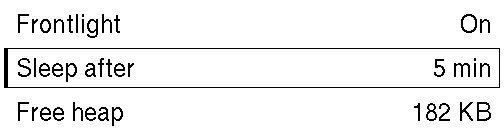
| Parameter | Meaning |
|---|---|
metrics | Row height, the gap between rows, the marker's width, and spacing_small either side of the text. |
rect | The list's area. Rows are laid from its top, as wide as it is. |
rows | How many rows there are. |
selected | The row to mark, zero-based. Any number that is not a row, -1 included, marks none. |
row | Called with a row's index and a RowField; None omits that field. |
Every row is the same height: list_row_height, or
list_row_height_with_subtitle if any row has a subtitle, the rule
row_height states and xpui's List measures with. Rows are
list_row_gap apart. The title is drawn left in the interface face, a subtitle
under it in the small face with the pair centred as a block, and a value
right-aligned in the interface face. The value is placed first, and the title
gets the room left beside it; either is cut with an ellipsis when it runs out.
Selection is a marker, not an inversion. Text is always ink, so filling the
row black would erase its label. The selected row gets a bar
selection_marker_width wide down its leading edge and an outline around it.
A row that would be cut is not drawn. A partly visible row reads as a
rendering fault rather than as "there is more below", which is what the scroll
indicator is for. So a list can leave up to a row's stride empty at the bottom
of rect; rows_that_fit says how many rows it drew.
Example — a settings list
use xpui::host::RowField;use xpui::testing::{self, RectKind};use xpui::Rect;use xpui_chrome::{Metrics, draw_list};
const ROWS: [(&str, &str); 3] = [("Frontlight", "On"), ("Sleep after", "5 min"), ("Free heap", "182 KB")];
let row = |index: usize, field: RowField| {  let (title, value) = ROWS.get(index)?;  match field {    RowField::Title => Some(*title),    RowField::Value => Some(*value),    RowField::Subtitle => None,  }};
draw_list(&Metrics::DEFAULT, Rect::new(16, 60, 448, 400), ROWS.len(), 0, &row);
let text = testing::drawn_text();let words: Vec<&str> = text.iter().map(|(_, _, word, _, _)| word.as_str()).collect();assert_eq!(words, ["On", "Frontlight", "5 min", "Sleep after", "182 KB", "Free heap"]);
// The marker and the outline, on the first row only.let rects = testing::drawn_rects();assert_eq!(rects, [(16, 60, 4, 40, RectKind::Filled), (16, 60, 448, 40, RectKind::Stroked)]);
Example — a row that does not fit
use xpui::host::RowField;use xpui::testing;use xpui::Rect;use xpui_chrome::{Metrics, draw_list};
let titles = ["One", "Two", "Three"];let row = |index: usize, field: RowField| match field {  RowField::Title => titles.get(index).copied(),  _ => None,};
// Two 40-pixel rows 4 apart take 84 pixels; a third would end at 128.draw_list(&Metrics::DEFAULT, Rect::new(0, 0, 400, 100), titles.len(), -1, &row);
let text = testing::drawn_text();let words: Vec<&str> = text.iter().map(|(_, _, word, _, _)| word.as_str()).collect();assert_eq!(words, ["One", "Two"]);
See also: row_height, rows_that_fit, draw_scroll_indicator
draw_option_popup
Section titled “draw_option_popup”A centred dialog: a cleared frame, a border, a title, and its options.
pub fn draw_option_popup<'a>( metrics: &Metrics, title: &str, options: &dyn Fn(usize) -> Option<&'a str>, count: usize, selected: i32,)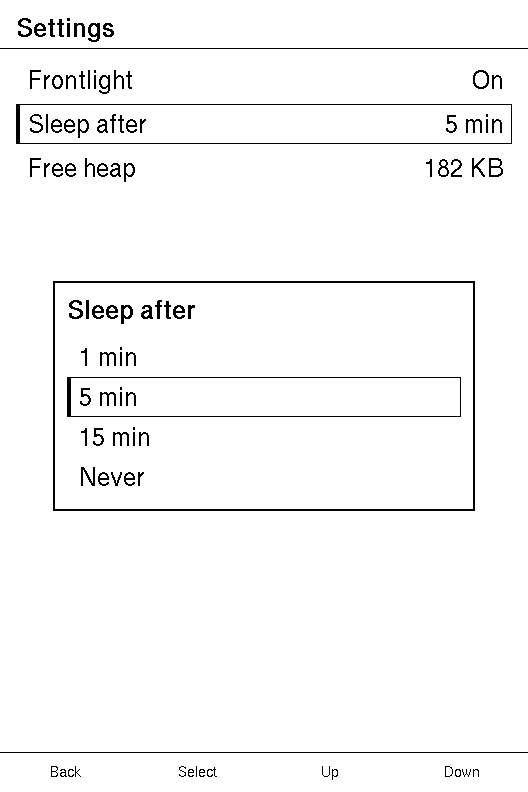
| Parameter | Meaning |
|---|---|
metrics | dialog_border, dialog_padding, dialog_width_percent, and list_row_height for each option. |
title | Drawn bold above the options. An empty title takes no room. |
options | Called with each index below the visible count; None leaves that row blank. |
count | How many options there are. 0 draws nothing. |
selected | The option to mark, as a list row is marked. Any number that is not a visible row marks none. |
Where the dialog goes is popup_layout's answer, and nothing
else's. It clears its frame to paper first, because a dialog sits over content
and its own background is the only thing making it legible; then it draws
dialog_border rings, the title, and each option as a one-line list row.
An empty dialog draws nothing: an empty frame looks like a dialog that failed to
load. xpui's Modal guards this too, but these functions are public.
Example — a picker
use xpui::testing::{self, RectKind};use xpui_chrome::{Metrics, draw_option_popup};
const FACES: [&str; 3] = ["Serif", "Sans", "Mono"];
draw_option_popup(&Metrics::DEFAULT, "Typeface", &|index| FACES.get(index).copied(), FACES.len(), 1);
// First the cleared frame, then the two rings of its border.let rects = testing::drawn_rects();assert_eq!(rects[0], (48, 311, 384, 177, RectKind::Filled));assert_eq!(rects[1], (48, 311, 384, 177, RectKind::Stroked));assert_eq!(rects[2], (49, 312, 382, 175, RectKind::Stroked));
let text = testing::drawn_text();let words: Vec<&str> = text.iter().map(|(_, _, word, _, _)| word.as_str()).collect();assert_eq!(words, ["Typeface", "Serif", "Sans", "Mono"]);
Example — no options, no dialog
use xpui::testing;use xpui_chrome::{Metrics, draw_option_popup};
draw_option_popup(&Metrics::DEFAULT, "Typeface", &|_| None, 0, 0);assert!(testing::ops_log().is_empty());
See also: option_popup_row_rect, popup_layout, draw_list
draw_scroll_indicator
Section titled “draw_scroll_indicator”A thumb down the right edge, proportional to how much is showing.
pub fn draw_scroll_indicator( metrics: &Metrics, rect: Rect, content: i32, visible: i32, offset: i32,)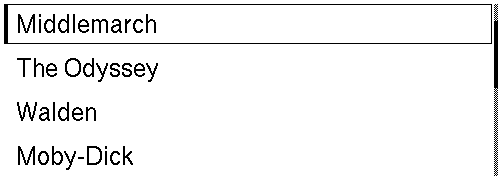
| Parameter | Meaning |
|---|---|
metrics | scrollbar_width, scrollbar_inset from the right edge of rect, and a thumb at least a quarter of min_touch_size long. |
rect | The scrolling region. The track runs down its whole height. |
content | How tall everything is. |
visible | How much of it the region shows. |
offset | How far down the region is scrolled, clamped to content - visible. |
It draws nothing when everything already fits, or when visible or content is
not positive: a full-height bar tells the reader there is more to see when there
is not. Otherwise a dithered track, and over it a solid thumb
height * visible / content long that reaches the bottom of the track at the
largest offset.
The thumb is never shorter than a quarter of min_touch_size, so a very long
page still shows something, and never longer than the track. xpui draws the
indicator after its scroll view lifts the clip, so the region's right edge is
where it lands, not the panel's.
Example — the top and the bottom of a page twice the window
use xpui::testing::{self, RectKind};use xpui::Rect;use xpui_chrome::{Metrics, draw_scroll_indicator};
let window = Rect::new(0, 60, 480, 700);
testing::reset();draw_scroll_indicator(&Metrics::DEFAULT, window, 1400, 700, 0);assert_eq!(  testing::drawn_rects(),  [(474, 60, 4, 700, RectKind::Dither), (474, 60, 4, 350, RectKind::Filled)]);
testing::reset();draw_scroll_indicator(&Metrics::DEFAULT, window, 1400, 700, 700);assert_eq!(testing::drawn_rects()[1], (474, 410, 4, 350, RectKind::Filled));
Example — everything fits
use xpui::testing;use xpui::Rect;use xpui_chrome::{Metrics, draw_scroll_indicator};
draw_scroll_indicator(&Metrics::DEFAULT, Rect::new(0, 60, 480, 700), 300, 700, 0);assert!(testing::ops_log().is_empty());
See also: draw_list