

Plain chrome
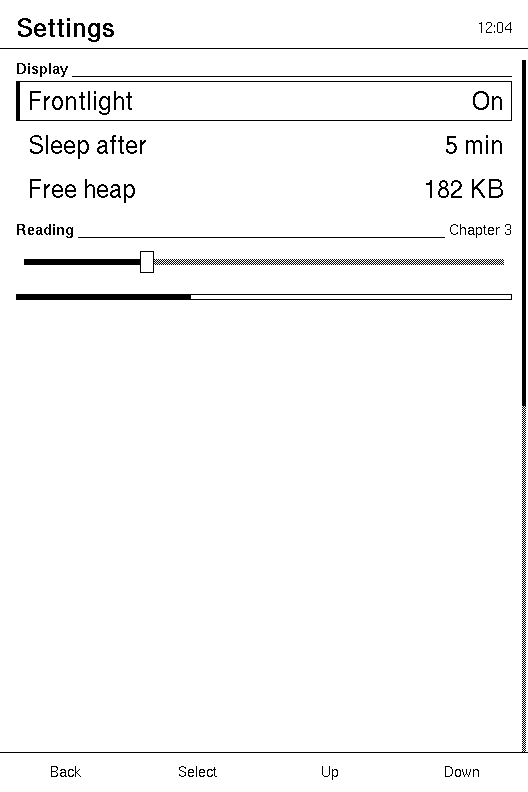
xpui deliberately has no opinion about what a list row looks like. It asks,
and a backend answers through its Chrome implementation. A backend sitting on
a component library answers by calling that library, and a Rust screen ends up
pixel-identical to a native one. A backend sitting on a drawing library has
nothing to call, and this macro is what it answers with: one invocation writes
the whole implementation from four things the backend passes in.
The host contract
is what a backend implements, and Chrome is the fifth of its traits. This page
is the macro that writes that one. Why it is a macro rather than a blanket
implementation is in design.md.
Topics
Section titled “Topics”plain_chrome! | Writes a complete Chrome implementation for a backend that supplies only primitives. |
plain_chrome!
Section titled “plain_chrome!”Writes a complete Chrome implementation for a backend that supplies only primitives.
macro_rules! plain_chromeplain_chrome! { for Backend, metrics: |backend| metrics, labels: |backend| labels, keys: |backend| keys, request_update: |backend| expression,}
plain_chrome! { generic: [parameters], for Backend<parameters>, metrics: |backend| metrics, labels: |backend| labels, keys: |backend| keys, request_update: |backend| expression,}The arguments are given in this order, and the trailing comma is optional.
| Argument | Meaning |
|---|---|
generic | Optional. The implementation's generic parameters with their bounds, [D: DrawTarget], spliced into impl<…>. |
for | The backend type the implementation is for. It must implement Canvas and TextMetrics, because everything painted goes through them. |
metrics | A &Metrics: every number the components paint to. See Metrics. |
labels | A &Labels: the words on the hint bar. See Labels. |
keys | A &KeyRow: which key sits in each slot of the hint bar, left to right. See KeyRow. |
request_update | An expression of type () that gets pixels onto the panel. |
The four things a backend passes in
Section titled “The four things a backend passes in”It asks for four things, because four parties own them. The metrics size
the chrome and come from whoever knows the panel. The labels are words, and
only an application knows what language its user reads. The key row says
which word sits over which key, which is a fact about the hardware. And
request_update is there because only a backend knows how to get pixels onto a
panel: it has no sensible default.
All four are written as closures over the backend, not plain values, so a
backend carrying its own can answer |backend| &backend.metrics. Two backends
in one process may be driving two different panels, in two different languages,
with two different key rows, and globals would give them one of each between
them. Why metrics, labels and keys are separate from each other is on
draw_button_hints.
What it writes
Section titled “What it writes”One impl Chrome for Backend, whose eleven methods each call this crate:
Chrome method | Answered by |
|---|---|
metric | Metrics::metric, on what metrics returns |
draw_header | draw_header |
draw_sub_header | draw_sub_header |
draw_button_hints | draw_button_hints, with metrics, labels and keys |
draw_progress_bar | draw_progress_bar |
draw_slider | draw_slider |
draw_scroll_indicator | draw_scroll_indicator |
draw_list | draw_list |
draw_option_popup | draw_option_popup |
option_popup_row_rect | option_popup_row_rect |
request_update | the request_update expression |
The implementation needs no use in the backend's crate: the macro names every
type through this crate.
Taking only some. Nine of the trait's eleven methods are also plain
functions, so a backend with some components of its own can take only the
ones it lacks rather than the whole implementation. The other two are not on
offer: metric is answered by Metrics::metric, and request_update is one of
the four things a backend passes in. No backend takes that route yet:
xpui-embedded-graphics takes all nine through the macro, and the FreeInkUI
backend answers Chrome over its own C ABI without depending on this crate.
Example — values in statics
use xpui_chrome::{KeyRow, Labels, Metrics};
static METRICS: Metrics = Metrics::DEFAULT;static LABELS: Labels = Labels::ENGLISH;static KEYS: KeyRow = KeyRow::READER;
xpui_chrome::plain_chrome! {  for MyBackend,  metrics: |_backend| &METRICS,  labels: |_backend| &LABELS,  keys: |_backend| &KEYS,  request_update: |backend| backend.flush(),}
Example — a backend carrying its own
use core::cell::Cell;use xpui::host::{Chrome, ThemeMetric};use xpui_chrome::{KeyRow, Labels, Metrics};
struct Badge {  metrics: Metrics,  labels: Labels,  keys: KeyRow,  dirty: Cell<bool>,}
xpui_chrome::plain_chrome! {  for Badge,  metrics: |badge| &badge.metrics,  labels: |badge| &badge.labels,  keys: |badge| &badge.keys,  request_update: |badge| badge.dirty.set(true),}
let badge = Badge {  metrics: Metrics::for_panel(296, 128),  labels: Labels::for_panel(296, 128),  keys: KeyRow::READER,  dirty: Cell::new(false),};assert_eq!(badge.metric(ThemeMetric::ListRowHeight), 24);badge.request_update();assert!(badge.dirty.get());
Example — a generic backend
use xpui_chrome::{KeyRow, Labels, Metrics};
/// A backend over any display type.struct Panel<D> {  display: D,  metrics: Metrics,}
static LABELS: Labels = Labels::ENGLISH;static KEYS: KeyRow = KeyRow::READER;
xpui_chrome::plain_chrome! {  generic: [D: Send],  for Panel<D>,  metrics: |panel| &panel.metrics,  labels: |_panel| &LABELS,  keys: |_panel| &KEYS,  request_update: |_panel| {},}
Example — what the written implementation paints
It paints through the installed host, so a call on the backend lands on
whichever canvas is installed: here, xpui's recording fake.
use xpui::host::{Chrome, Hint};use xpui_chrome::{KeyRow, Labels, Metrics};
struct Plain;
xpui_chrome::plain_chrome! {  for Plain,  metrics: |_backend| &Metrics::DEFAULT,  labels: |_backend| &Labels::ENGLISH,  keys: |_backend| &KeyRow::READER,  request_update: |_backend| {},}
xpui::testing::install();xpui::testing::reset();Plain.draw_button_hints(&Hint::Standard, &Hint::Done, &Hint::None, &Hint::None);
let text = xpui::testing::drawn_text();let words: Vec<&str> = text.iter().map(|(_, _, word, _, _)| word.as_str()).collect();assert_eq!(words, ["Back", "Done"]);
See also: Metrics, Labels, draw_button_hints, painting