

Icons
Twelve icons drawn from lines and rectangles, for a backend with no asset set.
A backend on a drawing library has no bitmaps to answer Canvas::draw_icon
with, so an icon leaves a hole, and an icon_size of 0 means the layout does
not even reserve space for it. These are drawn, not stored: no bitmaps, no font,
nothing in flash, and at 16 to 32 pixels on a 1-bit panel a drawn glyph and a
stored one look much the same.

They are not one of the eight components: xpui asks for an icon by kind,
through the host's Canvas, and IconRef::kind is opaque to the framework: the
host decides what 3 means. Icon is this crate's answer. A backend that ships
real assets maps the same names onto those instead.
Topics
Section titled “Topics”Icon | The icons this crate can draw. |
draw_icon | Draws icon with its top-left corner at origin. |
icon_size | The edge length this crate would actually draw, or 0 if it would draw nothing — which is how the framework knows to reserve no space. |
The icons this crate can draw.
pub enum Icon
#[repr(u16)], so a screen can write Icon::Sun and the number that crosses to
the backend is this enum's discriminant: the mapping is the enum, rather than a
table somewhere that has to agree with one. Icon converts into IconRef, in
its first variant at a 32-pixel edge, so it goes wherever xpui takes an icon.
| Variant | Kind | Solid variant | |
|---|---|---|---|
Icon::Sun | Brightness, a frontlight, daytime. | 0 | a filled disc |
Icon::Moon | Night, sleep, a dark theme. | 1 | the same: always filled |
Icon::Gear | Settings. | 2 | a filled disc |
Icon::ChevronLeft | Back, or previous. | 3 | the same |
Icon::ChevronRight | Forward, or next, or "this row opens something". | 4 | the same |
Icon::ChevronUp | Up, or previous. | 5 | the same |
Icon::ChevronDown | Down, or next, or "this opens below". | 6 | the same |
Icon::Check | A confirmation, or a setting that is on. | 7 | the same |
Icon::Cross | A dismissal, or a setting that is off. | 8 | the same |
Icon::Battery | Charge; every variant past the first fills the body. | 9 | a filled body |
Icon::Wifi | Wireless, in the usual three arcs. | 10 | the same |
Icon::Book | A book, a library, a document. | 11 | a filled cover |
Any IconRef::variant other than 0 asks for the solid one. The moon is always
filled: an outlined crescent is an arc with the bite erasing half of it, which
reads as a bracket.
Example — an icon in a screen
use xpui::{HStack, Icon as Glyph, IconToggle, hstack};use xpui_chrome::Icon;
#[derive(Clone, Copy)]enum Msg {  Light(bool),}
let row: HStack<Msg> = hstack![8;  Glyph::new(Icon::Book),  IconToggle::new(Icon::Sun, true).on_change(Msg::Light),];
Example — what crosses to the backend
use xpui::host::IconRef;use xpui_chrome::Icon;
let wifi: IconRef = Icon::Wifi.into();assert_eq!((wifi.kind, wifi.variant, wifi.size), (10, 0, 32));
let solid = IconRef { variant: 1, size: 24, ..Icon::Battery.into() };assert_eq!(solid.kind, Icon::Battery.kind());
Every icon
Section titled “Every icon”Icon::ALL
Section titled “Icon::ALL”Every icon, in the order of their kinds.
pub const ALL: [Icon; 12] = [ Icon::Sun, Icon::Moon, Icon::Gear, Icon::ChevronLeft, Icon::ChevronRight, Icon::ChevronUp, Icon::ChevronDown, Icon::Check, Icon::Cross, Icon::Battery, Icon::Wifi, Icon::Book,]A kind is looked up in this array, so a variant missing from it is undrawable:
icon_size answers 0 and draw_icon returns early.
use xpui_chrome::Icon;
for (index, icon) in Icon::ALL.into_iter().enumerate() {  assert_eq!(usize::from(icon.kind()), index);}
The number
Section titled “The number”Icon::kind
Section titled “Icon::kind”The number that crosses to a backend.
pub const fn kind(self) -> u16The discriminant, and what IconRef::kind holds for this icon.
use xpui_chrome::Icon;
assert_eq!(Icon::Sun.kind(), 0);assert_eq!(Icon::Book.kind(), 11);
See also: draw_icon, icon_size
draw_icon
Section titled “draw_icon”Draws icon with its top-left corner at origin.
pub fn draw_icon(origin: Point, icon: IconRef)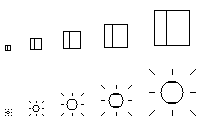
| Parameter | Meaning |
|---|---|
origin | The top-left corner of the icon's square. |
icon | kind is one of Icon's kinds; variant other than 0 asks for the solid one; size is the edge to draw at, as icon_size rounds it. |
It paints through the installed host with lines and rectangles alone, so a
backend with no bitmap font still has icons. It draws nothing for a kind that is
not an Icon, or for a size icon_size answers 0 to. A backend
answers Canvas::draw_icon and Canvas::icon_size with this function and its
neighbour.
Example — a check at 16 pixels
use xpui::host::IconRef;use xpui::testing::{self, DrawOp};use xpui::Point;use xpui_chrome::{Icon, draw_icon};
draw_icon(Point::new(100, 100), IconRef { size: 16, ..Icon::Check.into() });
let strokes = testing::ops_log()  .into_iter()  .filter(|op| matches!(op, DrawOp::Line { .. }))  .count();assert_eq!(strokes, 2);
Example — nothing to draw
use xpui::host::IconRef;use xpui::testing;use xpui::Point;use xpui_chrome::{Icon, draw_icon};
draw_icon(Point::new(0, 0), IconRef::new(99));draw_icon(Point::new(0, 0), IconRef { size: 6, ..Icon::Sun.into() });assert!(testing::ops_log().is_empty());icon_size
Section titled “icon_size”The edge length this crate would actually draw, or 0 if it would draw nothing — which is how the framework knows to reserve no space.
pub fn icon_size(icon: IconRef) -> i320 for a kind that is not an Icon, and 0 below 8 pixels, where the strokes
collide and a gear and a sun are the same smudge. Otherwise the requested size
rounded down to an even number: every glyph here is symmetric about its own
centre, and an odd edge puts that centre half a pixel off, which on a 1-bit panel
is the difference between a straight line and a stepped one. It needs no host.
use xpui::host::IconRef;use xpui_chrome::{Icon, icon_size};
let at = |size: i32| icon_size(IconRef { size, ..Icon::Gear.into() });assert_eq!(at(32), 32);assert_eq!(at(25), 24, "rounded down to an even edge");assert_eq!(at(8), 8);assert_eq!(at(7), 0, "too small to be worth drawing");assert_eq!(icon_size(IconRef::new(99)), 0, "not an icon this crate has");
See also: draw_icon